
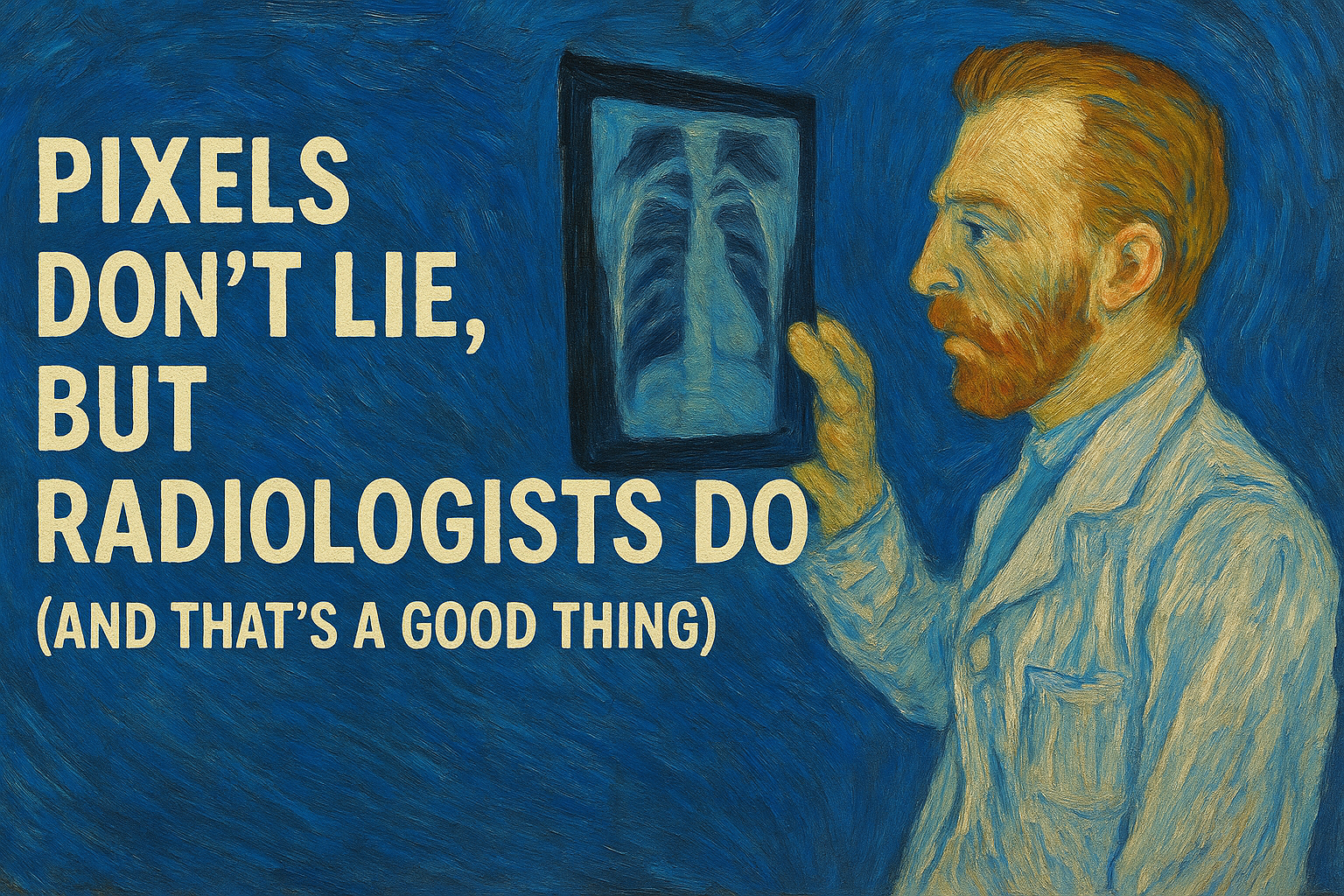
The first thing you learn in radiology is to trust the image. The X-ray doesn’t lie. The CT doesn’t have an opinion. The MRI doesn’t care who the patient is. It simply shows what is.
But after a few years, you realize that truth alone is not enough. Because medicine isn’t about perfect images, it’s about imperfect people. And people don’t come with clean margins or neat conclusions.
So yes, the pixels don’t lie. But radiologists do. Not the dishonest kind of lie—the human kind. The kind that bends hard data to fit the world we live in.
Think about it. You see a small nodule on CT, but you write “likely benign, follow up in six months.” You don’t say “possible early malignancy” because you know what that single word can do to someone’s mind. You choose to tell the truth gently. You leave space for hope.
Or maybe you see something that could be nothing or could be everything. You word it carefully, aware that your sentence will travel through clinicians, patients, and their families. You are not just reporting; you are translating.
That’s what machines can’t do. A computer can describe a pixel pattern with precision, but it doesn’t know fear, uncertainty, or the burden of a word like “suspicious.” A good radiologist knows that the report is not just a description of findings but a bridge between fact and feeling.
The image shows what exists. The radiologist decides how to say it. That is not deception. It’s wisdom. It’s empathy written in grayscale.
AI will keep improving, no doubt. It might someday read scans faster, sharper, and even catch things we miss. But it still won’t know how to tell the truth softly. It won’t understand what it means to be kind while being accurate.
And that’s why radiologists will always matter. Because while pixels may never lie, only humans know how to tell the truth in a way another human can bear.